Bitcoin integration
ICP’s Bitcoin integration lets canisters hold Bitcoin addresses, query balances and UTXOs, and sign and broadcast Bitcoin transactions, all without bridges or custodians. This page covers the protocol architecture: the Bitcoin adapter, the Bitcoin canister, the Bitcoin checker canister, and chain-key Bitcoin (ckBTC).
Architecture
Section titled “Architecture”The integration has two layers:
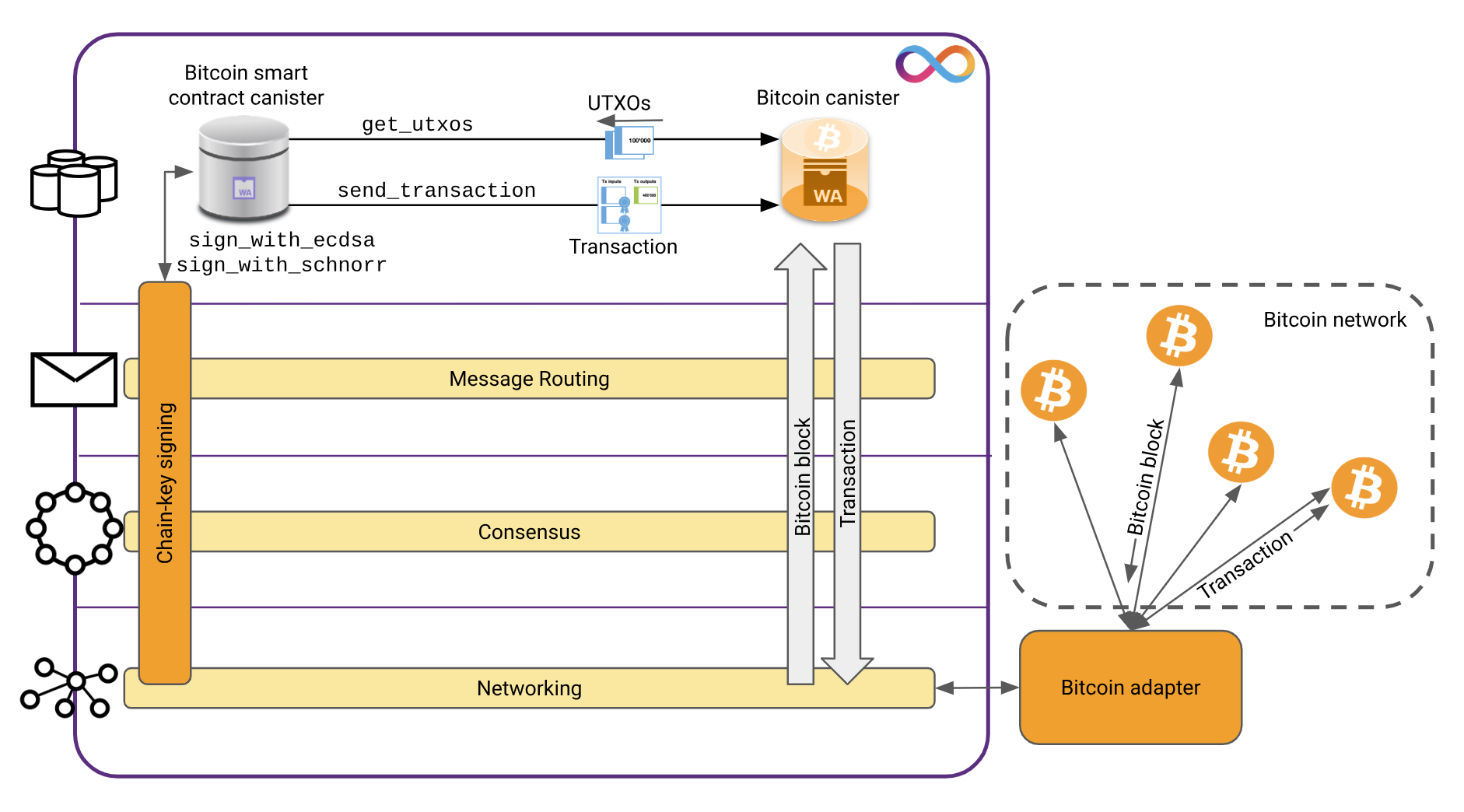
Protocol layer. ICP nodes run a Bitcoin adapter, a process separate from the replica that speaks the Bitcoin peer-to-peer protocol. The adapter connects to Bitcoin nodes, downloads blocks, and relays pending transactions. It keeps the replica informed about the latest Bitcoin state. Inside the replica, the Bitcoin canister (a canister running on a dedicated system subnet) processes blocks from the adapter, maintains the UTXO set for all Bitcoin addresses, and exposes a low-level API to other canisters.
Signing layer. Each canister can derive its own Bitcoin addresses through chain-key signatures. Because Bitcoin addresses are tied to ECDSA or Schnorr public keys, and the protocol can produce threshold signatures for those keys, a canister can authorize Bitcoin transactions without any node ever holding the full private key.
Together, these two layers give a canister the ability to receive bitcoin, check its balance, construct transactions, sign them, and broadcast them to the Bitcoin network.
Bitcoin canister API
Section titled “Bitcoin canister API”The Bitcoin canister exposes endpoints accessible directly by other canisters:
bitcoin_get_balance: returns the balance of any Bitcoin address.bitcoin_get_utxos: returns the unspent transaction outputs (UTXOs) for a given address. This is the primary input when constructing a Bitcoin transaction.bitcoin_get_current_fee_percentiles: returns recent fee rates so a canister can estimate an appropriate miner fee.bitcoin_send_transaction: broadcasts a signed transaction to the Bitcoin network via the adapter.bitcoin_get_block_headers: returns raw block headers for a range of heights.get_blockchain_info: returns current chain state including tip height, block hash, timestamp, difficulty, and UTXO count.
A typical flow for a canister spending bitcoin is: fetch UTXOs for its address, select inputs, build the transaction, call sign_with_ecdsa (or sign_with_schnorr for Taproot) for each input, then call bitcoin_send_transaction.
For canister IDs, cycle costs, and the full interface specification, see Bitcoin canisters.
Bitcoin checker canister
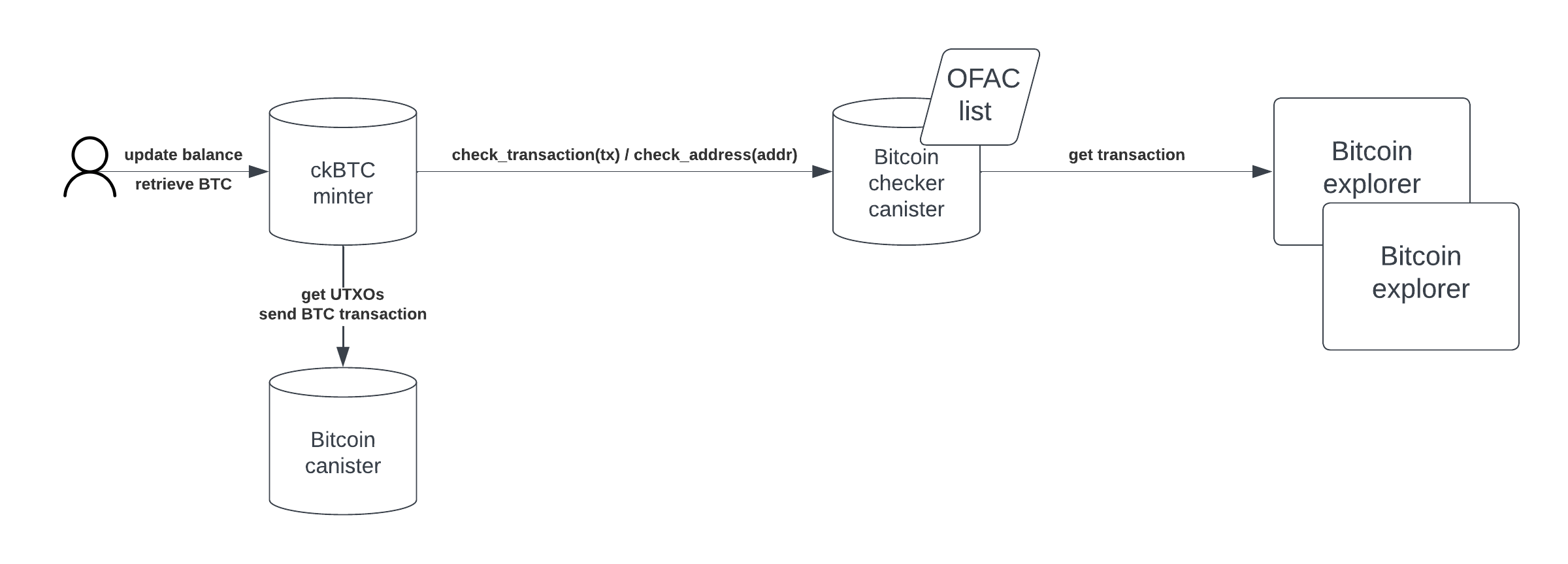
Section titled “Bitcoin checker canister”The Bitcoin checker canister (oltsj-fqaaa-aaaar-qal5q-cai) screens Bitcoin addresses and transactions against the OFAC Specially Designated Nationals (SDN) list. It is used by ckBTC and any canister that wants to avoid handling funds associated with sanctioned activity.
Two primary endpoints are available:
check_address: checks a single Bitcoin address against the SDN list. This is a simple lookup with no cycle cost.check_transaction: checks all input addresses of a transaction. The canister fetches the transaction and each of its inputs via HTTPS outcalls, derives the input addresses, and checks each one against the SDN list. Because of the HTTPS outcalls, at least 40 billion cycles must be attached; unused cycles are refunded.check_transaction_straccepts the transaction ID as a string instead of a blob.
Both endpoints return Passed or Failed. The canister itself is controlled by the NNS, so its SDN list can only be updated via a governance proposal.
Chain-key Bitcoin (ckBTC)
Section titled “Chain-key Bitcoin (ckBTC)”ckBTC is an asset on ICP backed 1:1 by real bitcoin. 1 ckBTC can always be redeemed for 1 BTC and vice versa. Unlike wrapped assets, ckBTC relies on no third-party custodian: the bitcoin is held by a canister-controlled address on the Bitcoin network, and the minting and burning happen entirely on the network.
ckBTC transactions settle in seconds with minimal fees, making it practical for high-frequency or low-value transfers that would be uneconomical on Bitcoin directly.
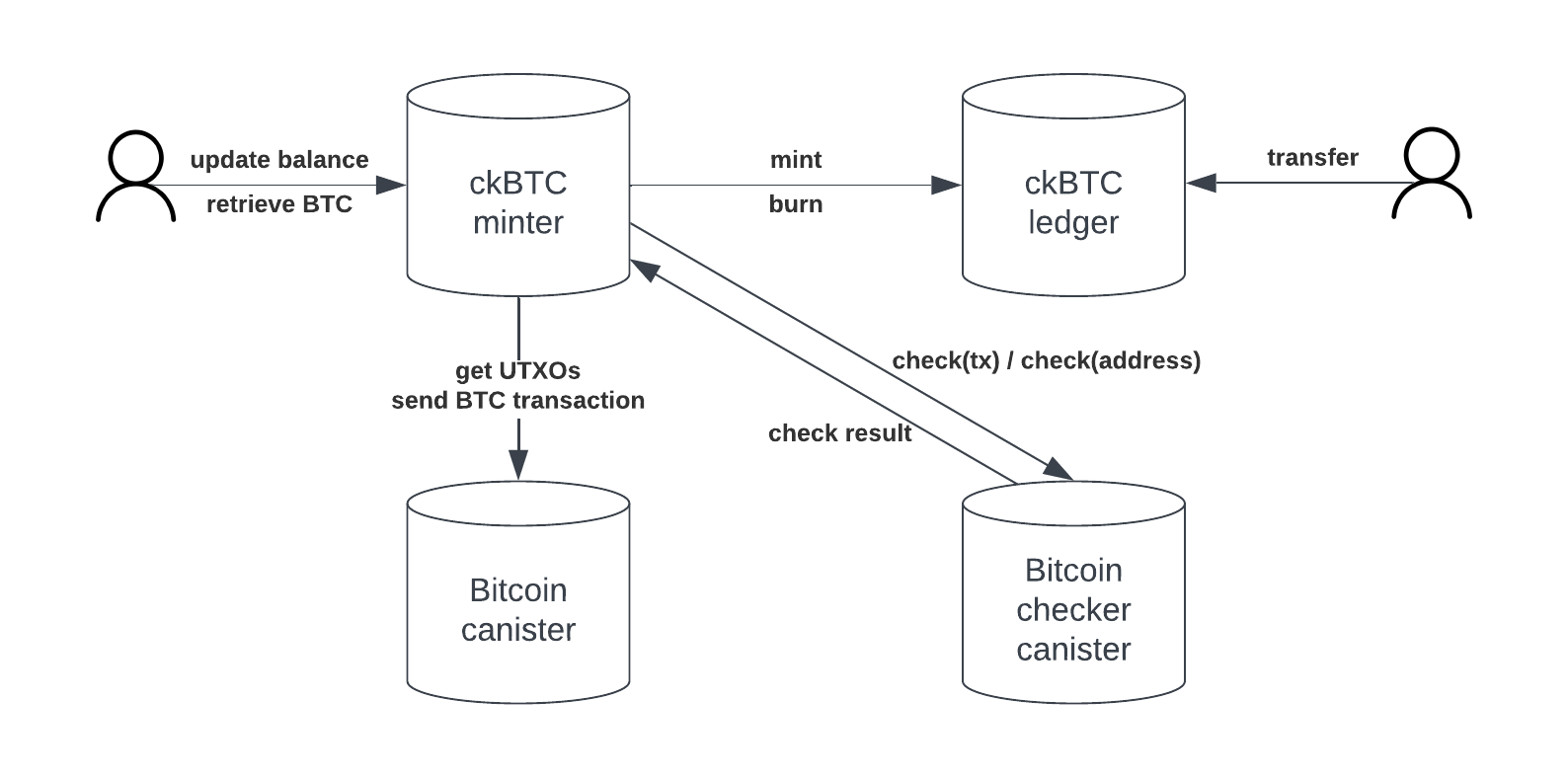
Two canisters run on the pzp6e subnet, both controlled by the NNS root canister. The ledger is an ICRC-1/ICRC-2 compliant ledger that records all ckBTC balances and handles transfers. The minter manages the BTC side: it controls Bitcoin addresses, tracks UTXOs, triggers minting when deposits arrive, and signs and submits Bitcoin transactions when users withdraw.
For canister IDs, minter parameters, and endpoint reference, see ckBTC minter and Chain-Key Token Canister IDs.
Converting BTC to ckBTC
Section titled “Converting BTC to ckBTC”- The user calls
get_btc_addresson the minter to receive a deposit address (a P2WPKH address) tied to their principal. - The user sends bitcoin to that address on the Bitcoin network.
- After 4 confirmations, the user calls
update_balanceon the minter. - The minter fetches UTXOs for the deposit address via
bitcoin_get_utxosand checks each new UTXO with the Bitcoin checker canister. UTXOs that pass the check are minted as ckBTC into the user’s ledger account (minus a KYT fee). UTXOs that fail the check are quarantined.
The 4-confirmation requirement protects against Bitcoin chain reorganizations.
Converting ckBTC to BTC
Section titled “Converting ckBTC to BTC”The recommended flow uses ICRC-2 approval:
- The user calls
icrc2_approveon the ckBTC ledger, authorizing the minter to withdraw the desired amount. - The user calls
retrieve_btc_with_approvalon the minter, specifying the amount and destination Bitcoin address. - The minter checks the destination address with the Bitcoin checker canister. If it passes, the minter burns the ckBTC from the user’s account and queues a Bitcoin withdrawal.
- The minter periodically batches pending requests, selects UTXOs, builds a Bitcoin transaction, signs each input using threshold ECDSA, and submits via
bitcoin_send_transaction.
Requests are batched to reduce Bitcoin miner fees. For the minimum withdrawal amount, fee formula, and UTXO consolidation behavior, see ckBTC minter.
Next steps
Section titled “Next steps”- Bitcoin guide: build Bitcoin transactions from a canister, with code and development setup
- Dogecoin integration: Bitcoin fork integration using the same architecture
- Chain Fusion overview: integration patterns and supported chains
- Chain-key cryptography: threshold ECDSA and Schnorr signing
- Protocol canisters reference: canister IDs, cycle costs, and API details
- Chain-Key Token Canister IDs: full ckBTC canister ID table including index and testnet